

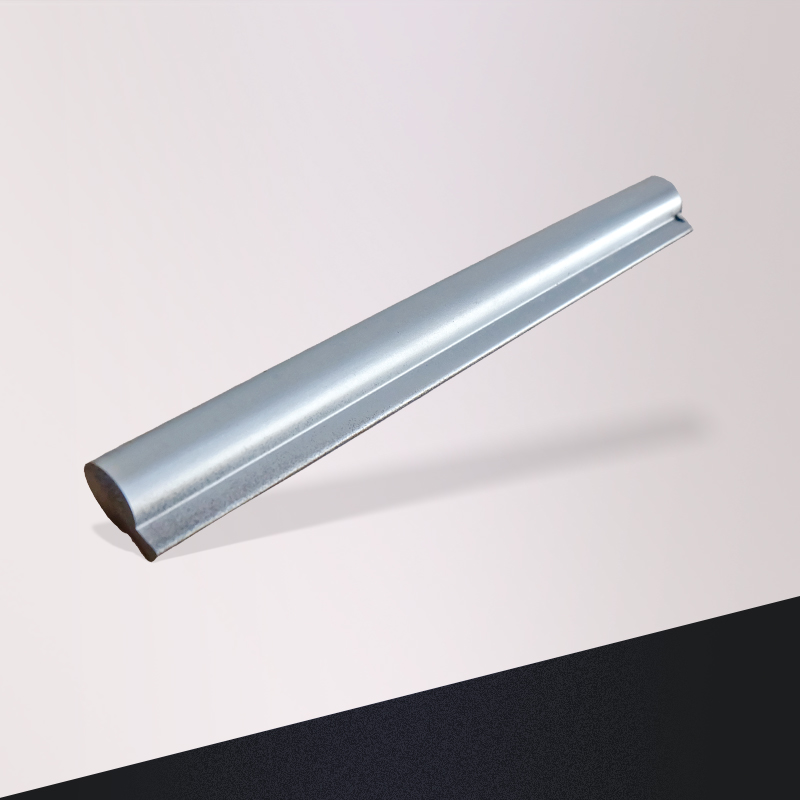
In the production of door products, door spindles, pin shafts and hinge mandrels serve as core components enabling door leaf rotation. Subjected to repeated friction and loads from continuous opening and closing, their raw material machinability directly affects mass production efficiency and component service performance. Conventional hot-rolled steel features surface scale, requiring large machining allowances before processing and increasing workload for turning and grinding. Cold-drawn steel for door spindles is formed by cold drawing at ambient temperature. The profiles deliver stable straightness and smooth surface finish, cutting down preliminary surface treatment procedures. It suits a wide range of door fitting manufacturing conditions for mass production of rotary components for various door leaves.
Cold-drawn steel for door spindles is mainly applied to manufacturing fittings for heavy-duty industrial large doors. Workshop gates and equipment protective doors have heavy self-weight, so door spindles must sustain the door weight continuously with constant friction during opening and closing. Cold working hardening occurs after cold drawing, improving surface wear resistance and slowing spindle wear under long-term reciprocating rotation. The profiles can be directly processed by turning, grooving and drilling with small machining allowances to reduce raw material waste. Consistent quality within each batch ensures stable fitting performance during assembly for mass production of pin shafts and supports parallel manufacturing of multiple sets of hardware for industrial large doors.
This profile can be adopted for hinge mandrel machining of security and explosion-proof doors. Such door leaves demand high structural stability and operate under vibrating and impact-prone environments. Cold-drawn steel for door spindles has uniform internal microstructure and resists deformation under alternating loads. After machining, the spindles can undergo heat treatment such as quenching to further boost surface wear resistance. Custom cut-to-length profiles reduce secondary cutting processes at factories and shorten component machining cycles, suitable for custom fabrication of pin shafts for explosion-proof doors and airtight doors.
It is also fit for mass production of hinge mandrels for indoor fire doors and passage doors. These products usually come in large order volumes and require continuous processing by automated CNC lathes. Free of heavy surface scale, cold-drawn steel supports automatic feeding for CNC equipment, lowering tool wear frequency and minimizing downtime for tool replacement. Profile cross-section sizes can be selected according to hinge designs. Small-diameter short shafts can be directly cut and machined to reduce scrap output and support continuous mass production at hardware factories.
For fittings of outdoor garden gates and perimeter gates, cold-drawn steel for door spindles mitigates component degradation in open-air environments. Exposed doors endure sunlight and rain, and door spindles need surface protection such as galvanizing. The smooth surface of cold-drawn steel delivers better coating adhesion, reducing the risk of coating peeling and delaying spindle corrosion. The profiles are easy to bend and process on end faces, and can be fabricated into special stepped shafts according to door manufacturers’ drawings to match hinge assembly for outdoor gates of diverse structures.
Cold-drawn steel for door spindles is also available for pin shaft fabrication of small equipment access doors and cabinet doors. These door bodies are relatively light in weight, while their fittings cover many specifications with small-batch and multi-variety orders. A wide selection of sizes for cold-drawn steel allows fast switching between profiles of different diameters for prototype development and small-batch production, facilitating door manufacturers to develop new door products.
Cold-drawn steel for door spindles is available in multiple diameter specifications. Raw material grades can be selected based on door leaf load requirements, and cut-to-length delivery is available upon customer requests. For new product development or mass fitting production, door hardware manufacturers can adopt cold-drawn steel for door spindles as raw material to simplify turning workflows, cut processing consumables and advance manufacturing projects of all types of rotary door components.

 phones Number:Panlixin 13706201799 Panliyong 13306238299
 Service Hotline:0512-52468216
 Company Address:Zhangjiaqiao, Xinzhuang Town, Changshu City
 Technical Support:Lange chain enterprise

Enterprise Wechat

Add Wechat
 Ch
 En
 Add wechat
 Contact us
 Telephones